“Ceramic or semi-metallic?”
That question gets asked at the parts counter thousands of times a day across the country. And most of the time, the answer comes down to whatever the customer had before or whatever is cheapest on the shelf.
That’s not a recommendation. That’s a coin flip.
If you’re a technician, service writer, or counter professional, you should be able to explain why one type works better than the other for a specific vehicle and driving pattern. Not because it makes for good conversation, but because the wrong pad type on the wrong application is how you end up with noise complaints, comebacks, and customers who don’t trust your shop anymore.
Here’s how to get it right every time.
The Fundamental Difference (In 30 Seconds)
Ceramic and semi-metallic brake pads stop vehicles using two different friction mechanisms. Understanding this one concept explains almost everything about how each type behaves.
Semi-metallic pads use abrasive friction. The metal fibers in the pad physically grind against the rotor surface. Both the pad and rotor lose material with every stop. That’s why semi-metallic pads produce heavy, dark brake dust and tend to wear rotors faster.
Ceramic pads use adherent friction. During break-in procedure, the pad transfers a microscopic layer of friction material onto the rotor face. After that, braking happens as pad material contacts pad material. The rotor itself isn’t the primary wear surface. That’s why ceramic pads produce lighter dust and are easier on rotors.
Neither mechanism is better. They solve different problems. The trick is matching the mechanism to the vehicle and how the customer uses it.
Head-to-Head Comparison
| Performance Factor | Ceramic | Semi-Metallic |
|---|---|---|
| Noise | Quiet across most conditions | Louder, especially cold or light braking |
| Brake Dust | Light colored, doesn’t stick to wheels | Heavy, dark, metallic dust |
| Cold Bite | Slightly less aggressive when cold | Strong initial bite even from cold |
| Heat Tolerance | Good for normal driving, fades under extreme sustained heat | Excellent under repeated hard braking and high heat |
| Rotor Wear | Lower (adherent friction is gentler) | Higher (abrasive friction removes rotor material) |
| Pedal Feel | Consistent, linear | Firm, more aggressive |
| Pad Life | Longer in normal driving conditions | Shorter in normal driving, longer under heavy-duty use |
| Cost | Higher per set | Lower per set |
| Best For | Daily drivers, commuters, European vehicles | Trucks, towing, fleet, performance |
When to Recommend Ceramic
Ceramic is the right call for about 80% of the vehicles that come through a typical shop. Here’s the profile:
Sedans, crossovers, and compact SUVs in daily driving. A 2024 Toyota Camry that commutes 30 miles each way doesn’t need the heat management of semi-metallic. Ceramic gives that customer quieter brakes, less dust on the wheels, and longer combined pad and rotor life.
European vehicles. European brake systems are designed around specific friction coefficients and NVH targets. A BMW 3 Series or Mercedes C-Class with semi-metallic pads will be louder than the owner expects. Euro-specific ceramic formulations (like DFC 5000 Euro Ceramic) are engineered to match OE friction characteristics for these platforms.
Any customer who complains about brake dust. If someone walks in and the first thing they mention is black dust all over their wheels, that’s a ceramic customer. Full stop.
Vehicles that sit for days between drives. Ceramic pads are less prone to creating the kind of surface corrosion issues that develop when semi-metallic pads sit against a rotor in humid conditions.
The customer who values quiet operation. Ceramic formulations dampen the high-frequency vibrations that cause brake squeal better than semi-metallic.
When to Recommend Semi-Metallic
Semi-metallic pads exist because some applications generate more heat than ceramic can handle. Period. That’s the deciding factor.
Full-size trucks and SUVs that tow. A Ford F-250 pulling a 10,000-pound trailer down a mountain grade needs pads that can absorb and dissipate enormous amounts of heat without fading. Semi-metallic formulations handle that.
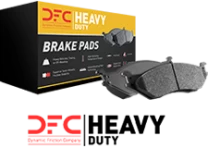
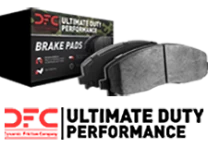
Fleet vehicles in stop-and-go duty cycles. Delivery vans, service trucks, and utility vehicles that spend all day in city traffic with frequent hard stops. For heavy fleet applications, DFC Heavy Duty and DFC Ultimate Duty Performance pads are formulated specifically for these duty cycles.
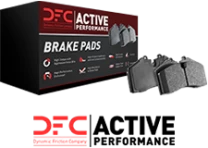
Performance driving. If your customer tracks their car, autocrosses, or drives aggressively, semi-metallic (or DFC Active Performance) gives them the heat resistance and aggressive bite they need.
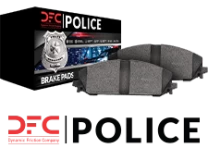
Police and first responder vehicles. DFC Police pads are AMECA certified and designed for pursuit duty cycles.
Work trucks with regular heavy loads. Landscapers, contractors, tow trucks. These vehicles operate at or near GVWR regularly.
The Gray Area: When It Could Go Either Way
Mid-size SUVs that occasionally tow. A Chevy Tahoe that tows a boat twice a summer? Ceramic is fine. That same Tahoe towing a 6,000-pound camper every other weekend? Semi-metallic.
DFC 4000 HybriDynamic pads blend ceramic and semi-metallic properties to handle mixed driving patterns without the noise penalty of full semi-metallic or the heat limitations of full ceramic.
Older vehicles with drum/disc combination brakes. The front brakes do most of the work, so a semi-metallic front pad paired with the drum shoe setup in the rear often makes sense.
Customer preference conflicts with the application. Explain the tradeoffs honestly. Set expectations and let them decide.
The Quality Variable That Matters More Than Type
The quality gap between a cheap pad and a good pad within the same category is bigger than the gap between ceramic and semi-metallic in most applications.
What separates a quality pad from a cheap one:
Vehicle-specific formulations. A DFC 5000 Advanced pad for a Honda CR-V uses a different friction compound than a DFC 5000 Advanced pad for a Ram 1500. Budget brands use one compound across hundreds of applications.
Post-curing. DFC post-cures 100% of its brake pads, stabilizing friction material before the pad ships.
Material quality. Better raw materials, tighter tolerances on fiber length and distribution, more consistent resin binders.
Backing plate quality. Precision-stamped plates with controlled flatness tolerances prevent noise and uneven wear.
The Counter Conversation: A Script That Works
Step 1: What’s the vehicle? Sedan or crossover? Almost certainly ceramic. Full-size truck? Depends on usage.
Step 2: How do they use it? “Do you tow anything regularly?” and “What kind of driving do you mostly do?”
Step 3: Any complaints about the current setup? Dust = ceramic. Fade = semi-metallic. Noise = specific formulation issue.
Step 4: Match the recommendation to the application.
| Vehicle Type | Primary Use | Recommendation | DFC Product |
|---|---|---|---|
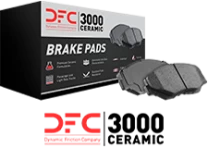
| Sedan / Compact | Daily driving | Ceramic | DFC 3000 Ceramic or DFC 5000 Advanced |
| Mid-size SUV / Crossover | Daily driving | Ceramic | DFC 5000 Advanced |
| Mid-size SUV | Mixed with light towing | Hybrid | DFC 4000 HybriDynamic |
| Full-size truck | Daily, no towing | Ceramic or Hybrid | DFC 5000 Advanced or DFC 4000 HybriDynamic |
| Full-size truck | Regular towing | Semi-metallic | DFC Heavy Duty |
| Work truck / Commercial | Heavy-duty daily | Semi-metallic | DFC Ultimate Duty Performance |
| European sedan / SUV | Any | Euro ceramic | DFC 5000 Euro Ceramic |
| Performance vehicle | Spirited / track | Performance | DFC Active Performance |
| Police / First responder | Pursuit rated | AMECA certified | DFC Police |
Step 5: Set expectations. If switching from semi-metallic to ceramic, tell them the pedal will feel different. If switching the other way, warn them about dust and noise.
One More Thing: Matched Components Matter
A ceramic pad on a cheap rotor with inconsistent metallurgy won’t perform like a ceramic pad on a quality rotor. When the pad and rotor are designed as a system, break-in is faster, the transfer film develops more evenly, and NVH performance is better.
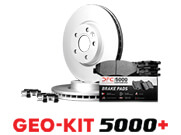
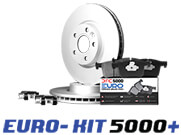
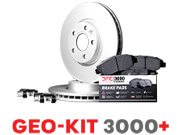
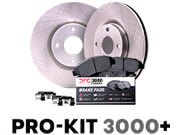
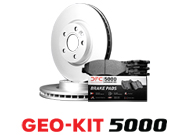
DFC offers complete brake kits with matched pads, rotors, and hardware. Find the right kit at dynamicfriction.com.
The ceramic vs semi-metallic question doesn’t have a universal answer. But it does have a right answer for every specific vehicle and driver.

UNITED STATES